
Difference Between Autoclave and Hot Air Oven for Laboratory Use

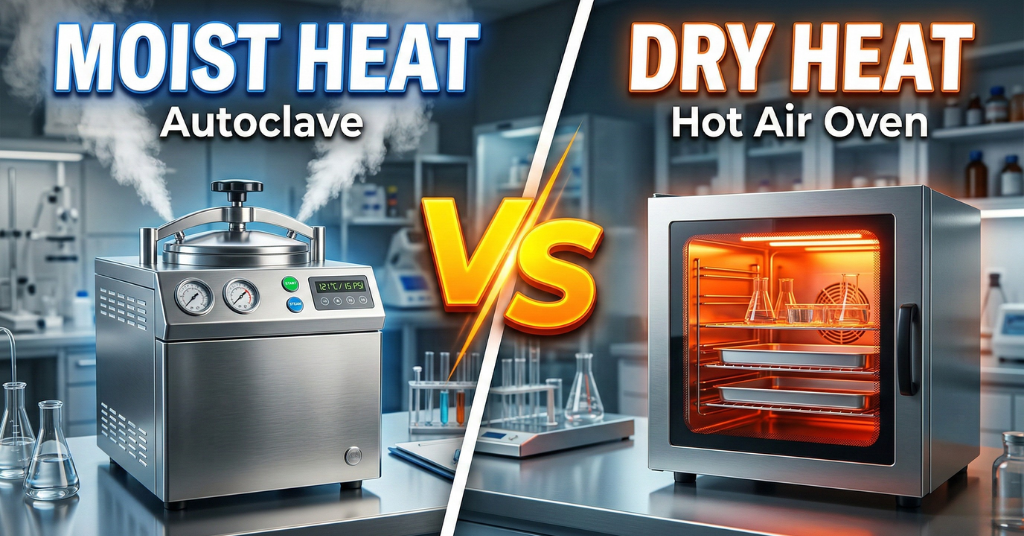
In the professional world, the right sterilization techniques for lab research and medical diagnostic procedures are an important decision that can impact the outcome and lifespan of the equipment. If the right sterilization techniques, i.e., moist heat vs. dry heat, are not selected, it can damage the equipment, which can be sensitive to high temperatures, or it can be difficult for the sterilization agents, i.e., bacterial spores and thermophiles, to be killed. This guide will discuss the technical difference between Autoclave and Hot Air Oven, which can be helpful for the right decision.
Expert Source: This article is supported by Panomex Pvt. Ltd, an ISO & CE Certified manufacturer with over 35 years of experience in high-end lab sterilizers and scientific equipment.
What is an Autoclave ?
An autoclave is a specialized pressure chamber designed for moist heat sterilization . It uses saturated steam under pressure to eliminate all forms of microbial life. Autoclaving refers to a process of instrument sterilization that is highly efficient because steam can carry significantly more thermal energy than dry air. Standard lab sterilizers of this type are essential for liquid media sterilization and handling biohazardous waste.
What is a Hot Air Oven?
A hot air oven is a sterilization unit that uses to dry heat (hot air) to achieve sterility. Unlike its steam-based counterpart, hot air ovens utilize circulating air for sterilization at atmospheric pressure. Since a hot air oven has a lower heat capacity than steam, it requires much higher temperatures and a longer processing time compared to autoclaves to be effective.
How Autoclave Works (Moist Heat Mechanism)
The core of Autoclave vs hot air oven for sterilization lies in how they interact with cellular structures. An autoclave works through the coagulation of proteins. When the saturated steam under pressure contacts a cooler surface, it condenses and releases latent heat, which causes the structural proteins of bacteria and spores to clump and lose their function. This provides superior heat penetration in a fraction of the time.
How Hot Air Oven Works (Dry Heat Mechanism)
The Hot Air Oven vs Autoclave mechanism is fundamentally different, relying on the oxidation of cell constituents. In a hot air oven, the dry heat slowly removes moisture from the microorganisms, essentially “burning” the cellular components through oxidation. This dry heat sterilization vs steam sterilization process is slower because air does not transfer heat as efficiently as water vapor.
Autoclave vs Hot Air Oven: Quick Comparison Table
This Comparison of laboratory sterilization equipment table provides a Quick Comparison Summary of the two most common sterilization types:
| Feature | Autoclave | Hot Air Oven |
| Heat Type | Moist Heat (Steam) | Dry Heat (Air) |
| Mechanism | Protein Coagulation | Oxidative Damage |
| Temp/Time | 121°C at 15 psi for 15-20 mins | 160°C to 180°C for 2 hours |
| Pressure | High Pressure (15 psi) | Atmospheric Pressure |
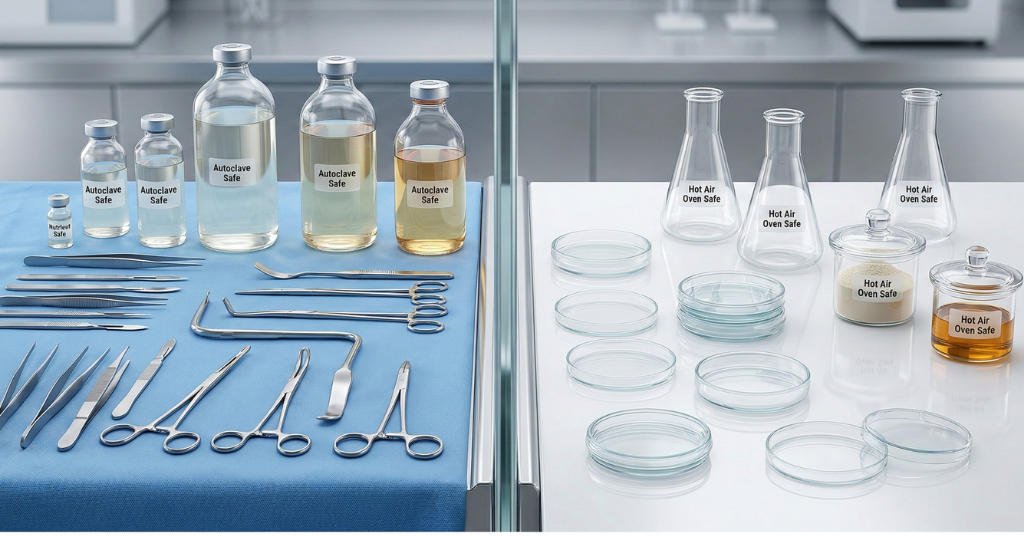
| Best For | Surgical tools, media sterilization | Glassware, powders, oils |
Sterilization Temperature & Time (121°C vs 160°C)
The main difference between autoclave and hot air oven is clearly visible in the sterilization temperature and time
Autoclave : It is normally sterilized at 121°C as opposed to 160°C in hot air ovens. as steam is highly effective, the sterilization time is as short as 15 – 20 minutes.
Hot Air Oven : For the same level of microbial load reduction, hot air ovens require a temperature of 160°C to 180°C. Because of poor heat transfer, the sterilization time must be at least 2 hours.
Pressure Settings & Their Role
Pressure is the secret to why an autoclave is so fast. It operates under High Pressure (up to 2 bars), typically 15 psi pressure, which allows water to reach a higher temperature without boiling away into “dry” steam. A hot air oven operates with No Pressure, relying entirely on thermostatic control to circulate hot air.
What Materials Can Each Sterilizer Handle ?
When deciding which one to use between Autoclave vs Oven , there are certain materials that each device can handle .
- Glassware and surgical equipment : Glassware is better handled by the oven to prevent moisture from accumulating, while surgical equipment made from stainless steel is better handled by the autoclave.
- Sensitive materials : Some materials, such as plastic and certain chemicals, may not withstand the high temperatures used by the hot air oven .
When to Use Autoclave
- Media sterilization: Essential for liquids and nutrient broths.
- Surgical tools: Standard for medical grade sterilization.
- Steam cycles: Ideal for high-turnover labs requiring rapid results.
When to Use Hot Air Oven
- Glassware : Keeps flasks and Petri dishes dry and spot – free .
- Anhydrous materials : Choose a hot air oven if you’re working with dry materials like oils, fats, or powders that steam cannot penetrate.
- Dry heat cycles : Preferred for metal tools that are prone to rusting in moisture.
Protein Coagulation vs Oxidation (The Science)
The difference between autoclaving and hot air oven sterilization comes down to molecular destruction. Protein Coagulation in the autoclave is like boiling an egg it happens fast and requires moisture. Oxidation in the oven is more slow – roasting it requires a much higher energy state to break down the carbon-to- carbon bonds in microbial cells.
Sterilization Indicators (Biological & Chemical)
To ensure the difference between autoclave and hot air oven performance is meeting standards, you must use sterilization indicators.
- Chemical Indicators : Tape or strips that change color when a temperature is reached.
- Biological Indicators : Vials of bacterial spores that are tested after a cycle to prove 100% lethality.
Heat Penetration Power
The penetration power of steam is the defining factor in the difference between autoclave and hot air oven efficiency. Steam is a dense gas that collapses upon contact with cool surfaces, drawing more steam into the smallest crevices of surgical tools. Dry air simply blows over surfaces, making heat penetration much slower.
Common Mistakes (Autoclave & Oven)
- Overcrowding : Blocking circulating air in an oven or steam flow in an autoclave prevents proper heat penetration.
- Improper Packaging : Using sealed containers in an autoclave can lead to explosions due to pressure settings (psi/bar).
Comparison & Buying Guide
When reviewing a sterilizer guide, consider these factors before purchase:
- Material Compatibility: Will you be processing glassware vs surgical instruments?.
- Throughput: Do you need the rapid sterilization time of steam?.
- Safety: Does the unit have advanced thermostatic control and pressure relief valves?.
Before You Buy, Pay Attention to These 5 Things
Focus on these high-intent parameters:
- Holding time accuracy.
- Pressure settings (psi/bar) range.
- Chamber size for your specific lab equipment.
- Corrosion and rusting risks for your specific tool metals.
- Energy consumption differences between dry heat cycles and steam cycles.
Safety Precautions & Best Practices
- Always wear heat -resistant gloves when handling medical grade equipment.
- Check seals regularly to prevent steam leaks in autoclaves.
- Ensure the thermostatic control is calibrated annually for both units.
Cost Comparison
While a hot air oven generally has a lower initial purchase price, the longer processing time compared to autoclaves can lead to higher long -term labor and energy costs. Autoclaves are an investment in speed and reliability .
Maintenance & Longevity
Regular maintenance of lab sterilizers includes descaling autoclave chambers and checking the heating elements of hot air ovens. Panomex Pvt. Ltd units are designed for decades of service with minimal upkeep.
Case Study : Optimizing a Diagnostic Lab
A mid -sized diagnostic lab in Delhi recently evaluated the difference between autoclave and hot air oven usage. By switching their glassware sterilization to a dedicated Panomex Hot Air Oven, they freed up their autoclave for 40% more media sterilization cycles, significantly increasing their daily testing capacity.
Final Quality Summary
- Autoclave: Best for speed, liquids, and surgical tools using Moist Heat.
- Hot Air Oven: Best for glassware, oils, and preventing corrosion and rusting risks using Dry Heat.
Take the Next Step: View our full range of ISO & CE Certified sterilization solutions at Panomex.com to find the perfect fit for your laboratory.
Final Conclusion: Understanding the difference between autoclave and hot air oven is essential for any modern laboratory. By following this 2026 Sterilization Guide, you can ensure your facility maintains the highest levels of safety and efficiency.
FAQs
Which is more effective : an autoclave or a hot air oven?
The autoclave method is more effective and quicker, as moist heat (saturated steam) has a greater penetration power compared with dry heat. Autoclaving can be completed at lower temperatures (compared with the hot air oven, which requires 160°C +).
Can glassware be sterilized with the autoclave?
Yes, it can be sterilized, although the hot air oven is the preferred method for glassware, as it remains dry and spot -free after sterilization . If the autoclave method is chosen, the glassware must not be hermetically sealed, as explosions can occur due to the pressure.
Why does the hot air oven take longer than the autoclave?
This is because the hot air oven depends on oxidation, which occurs slowly compared to the coagulation that occurs in the autoclave. This is because dry air loses heat slowly , which means that it has to be left for at least 2 hours.
What is the standard temperature for hot air oven sterilization ?
The standard temperature for the hot air oven ranges from 160°C to 180°C .
Is the autoclave suitable for oils and powders?
No, the autoclave is not suitable for oils, fats, and powders, which are anhydrous, i.e., do not allow the entry of steam . Oils, fats, and powders are sterilized by the hot air oven.
What pressure is used for the standard autoclave cycle?
The standard pressure for the autoclave cycle is 15 pounds per square inch, which is equal to 1.05 bar.
How do I know that the sterilization process has been successful?
You can use sterilization indicators, which can be chemical indicators that change color, and biological indicators that prove 100% lethality.
Are there any chances for the surgical equipment to rust inside the autoclave?
Yes, there are chances for the equipment made of metal to rust inside the autoclave, as steam is present during the sterilization process.
What are the 5 things to check before buying a laboratory sterilizer ?
The accuracy of holding time, pressure settings range (in psi or bar), the size of the sterilizer, the risk of corrosion of the equipment, and the total energy consumption are the things to check before buying a sterilizer.
Why is Panomex equipment recommended for laboratory use?
Panomex equipment is ISO & CE Certified with over 35 years of manufacturing experience.